Roll-Off Trucks Only
Roll-Offs In Stock.Ready To Haul.
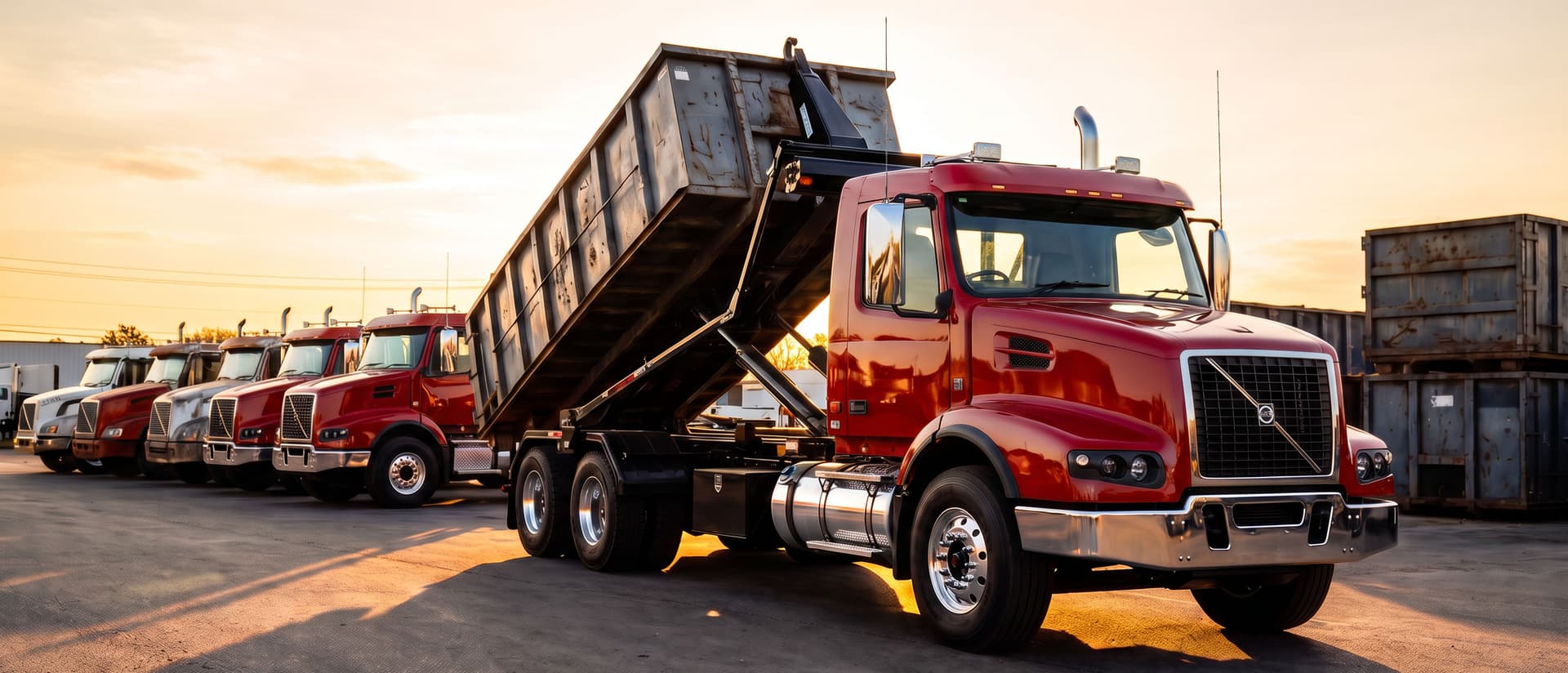
New and pre-owned roll-off trucks, on the lot in Tampa and ready to work. Hoists, grapple bodies, and the chassis you spec — with parts and service in-house.
Large Roll-Off Selection
New and pre-owned roll-offs in stock and ready to go — single axle, tandem, and tri-axle configurations.
View Roll-Off InventoryPac-Mac Authorized Dealer
Roll-off hoists and grapple bodies built for heavy municipal and commercial duty, mounted on the chassis you spec.
Explore Pac-Mac HoistsInspected & Verified
Every truck is inspected before it hits our lot, backed by 44+ years of refuse-truck expertise and in-house parts and service.
Visit Us in TampaThe Standard Spec
We Order The Same TruckOver And Over
Look through our roll-offs and they start to look identical. That's on purpose. After enough years of ordering these, the configuration below is what came out the other side — a truck specced to run heavy containers all day and keep doing it long past the point where a lighter build would be in the shop. Here's the spec and the reasoning behind each piece of it.
Gross rating
66,000 lb GVWR
Titled and rated to carry it — 20,000 lb on the front axle plus 46,000 lb on the rear. The rating is the sum of the running gear under it, not a round number picked off a brochure.
Hoist
60,000 lb
Sized so a full container is routine work rather than a maximum effort. A hoist pulling at its ceiling every day is a hoist you'll be rebuilding early.
Drive & suspension
Tandem, T-Ride Or Hendrickson
Two drive axles to carry the weight and keep traction on a soft job site. Single-axle roll-offs exist; they don't hold up to this duty cycle.
Transmission
Allison 4500 RDS
An automatic built for rugged duty. A container route is hundreds of shifts a day under load, and this is the one that survives it without a clutch bill.
Rear ratio
4.56
Geared to pull a loaded can up a transfer-station ramp without lugging the driveline. If most of your miles are long-haul, say so and we'll spec taller.
Power
455 hp, D13 Or X12
Volvo D13 or Cummins X12, with an engine brake on essentially every unit — because bringing a loaded can down a grade is harder on a truck than taking it up.
Why this spec lasts
Nothing On It Is Working At Its Limit
46,000 lb
Rear axle and suspension capacity under the tandem
60,000 lb
Hoist rating, on a 22-ft outside-rail container
300,000+
Miles we've seen these come in on trade and go back out working
Heavy loads don't break a truck in one trip. They break it through repetition — a hoist cycling near its rating, an axle carrying everything it's rated for, a driveline lugging under weight it was barely geared for. Do that four hundred times a month and the bills arrive on schedule.
This spec is built the other way around. The axles, the hoist, and the transmission are all rated past what a normal load asks of them, so the work that wears out a lighter truck is just Tuesday for this one. That's the reason trucks in this configuration come back through our lot with a quarter million miles on them and still sell.
None of this is a package you're stuck with. It's where we land when nobody tells us different — so tell us different. Longer wheelbase, taller gearing, a 75,000-lb hoist, a lift axle: that's an order, and we'll walk the spec sheet with you line by line.
Factory-Authorized Dealer
Pac-Mac Roll-Off HoistsBuilt In Mississippi
Pac-Mac is a division of Hol-Mac Corporation, and the hoists are built in Bay Springs, Mississippi — cylinders included. We're a factory-authorized Pac-Mac dealer, which means OEM parts, factory training, and direct manufacturer support instead of third-party sourcing when something needs attention. It's also the body under most of the roll-offs on our lot, so the people selling it are the people who service it.
RO60 hoist — manufacturer specification
60,000 lb
Rated hoist capacity. A 75,000-lb version is built on the same platform if your loads run heavier.
8″ × 4″ × ½″
A500 B main frame tubing, on a 4″ × 2″ sub frame. This is where a hoist either lasts or doesn't.
49°
Tilt angle, so sticky and wet loads actually clear the box instead of riding back to the yard.
22 ft
Maximum outside-rail container length, up to 8 ft tall. Check this against the cans you already run.
7⁄8″ cable
Running over 10″ bronze-bushed sheaves on 2½″ pins, with four forged cable clamps at the anchor.
ANSI Z-245
Compliant, with automatic roller lock, spring-loaded container lock, and dual maintenance props.
Designed To Be Worked On
Most of what separates a good hoist from a cheap one shows up three years in, at the point where something has to be greased, replaced, or diagnosed. Pac-Mac builds for that, and as the shop that services these, we notice:
- Every lube fitting reachable from ground level — no climbing, no crawling under a raised hoist
- Wiring routed through a full-length steel conduit rather than strapped along the frame
- Bolt-on replaceable steel fenders, rear sheave guards, and light boxes — wear parts you swap, not weld
- Side rollers on double-shear mounts with replaceable greasable pins
- Hydraulic reservoir behind the cab, which runs cooler and stays cleaner than a frame-rail tank
- Scale-ready rear pivot — a bolt-on scale kit goes on later with no modifications
We mount them on the chassis you spec. What's moving through here now is mostly Volvo VHD64 and Freightliner 114SD, with Mack GR64B as well — tandem, 66,000 GVWR, Allison behind a 455-hp engine. Tell us the route and we'll tell you what fits it.
Lease & Rental
You Need The Truck WorkingYou Don't Need To Own It
A roll-off tied up in capital is still a roll-off sitting in the yard between jobs. If your work runs in project cycles, or you're covering a contract you didn't have last quarter, or you're replacing an aging fleet without a capital request — there's a version of this that isn't a purchase.
13 to 60 months
Lease It
A new truck under the manufacturer's full factory warranty, on a fixed monthly cost you can budget three years out. When it goes in for service, a rental covers the route — your work doesn't stop because the truck did. Most fleets land on 36 months; it lines up with multi-year route contracts.
Three ways to structure it
- Walk-away. Hand it back at term end. No buyout, no balloon payment, no surprise settlement.
- Purchase option. Same lease, with the right to buy at a price agreed up front.
- Fair market value. Lower monthly through the term, purchase price set by the market at the end.
Month to month, under 12 months
Rent It
For a job with an end date, a seasonal push, or a truck that's down and taking a route with it. Short-term roll-off rentals come to you fueled and ready to work, and extend on the same monthly rate as long as the term stays under a year.
Florida public agencies — published rate
Awarded rate on Florida Sheriffs Association contract FSA25-VEH23.0, Item 89, Option RDKR. Any Florida governmental entity can order directly off the cooperative — no separate solicitation, no piggyback resolution. Commercial haulers, call for a rate on your term.
Nothing Hidden At The End Of The Term
At lease end you walk away, buy the truck at residual, extend the term you're in, or roll into a new one — your call, not ours. Return conditions are spelled out in writing before you sign, not discovered at turn-in. Have an aging fleet? Trade-in options can roll it into the new arrangement.
Buyer's Guide
Cable Hoist Or Hook Lift?Your Containers Decide
Both systems load, haul, and dump a container. The difference is how the truck connects to it. A cable hoist uses a winch and cable that the driver hooks to the container by hand. A hook lift uses a hydraulic hook arm the driver engages from the cab. That one difference drives everything else — where each one can work, how fast it cycles, and which containers it can pick up at all.
Cable Hoist
A winch pulls the container up the rails on its own wheels. The driver gets out, pulls the cable, hooks it to the container, and returns to the controls. This is what most of the North American waste, recycling, scrap, and C&D market runs.
Better when
- Overhead is tight. The rail angle adjusts, so you can pick and dump at a much lower angle — inside a building or under an obstruction where a hook arm has nowhere to go.
- Loads are heavy. The cable pulls the weight up the rails and the incline changes as it comes, which keeps cable tension down instead of lifting everything on one fixed geometry.
- You run mixed container lengths. Almost any length works as long as it doesn't hang past the tail of the rails. Hook lifts are generally held to within a few feet of their shortest rated body.
- Your cans vary in style. Cable hoists handle both inside-rail and outside-rail containers.
Hook Lift
A hydraulic hook arm reaches out, catches a bar on the container, and lifts it aboard — all worked from the driver's seat. Long the standard overseas, and gaining ground here on municipal and multi-purpose fleets.
Better when
- Pick count is the whole business. No getting out, no dragging cable. Stellar, which builds both systems, estimates a hauler doing ten picks a day could get to about twelve — roughly a twelve percent gain.
- Safety drives the spec. The driver is never standing between the truck and the container, and never hauling a heavy cable through mud. That removes a whole category of back, hand, and strain injuries.
- Space is tight or placement has to be exact. Hook lifts set a can down more precisely and need less open room ahead of the truck to work in.
- You load off a dock, or want one truck to do five jobs. Hook lifts handle elevated loads a cable system can't, and swap between dump bodies, flatbeds, and tanks on the same chassis.
The part nobody tells you
The Containers You Already Own Decide This
The two systems don't share cans. A cable container has a hook and rollers; a hook lift container needs a lifting bar at the right height. If you own twenty cable cans, buying a hook lift truck means converting or replacing twenty containers — and that math almost never works. It's the reason cable hoists still dominate refuse and scrap hauling here, even where a hook lift would cycle faster.
Which flips the answer if you're starting from nothing. New to hauling, or replacing a fleet outright? That's when a hook lift deserves a serious look, because you're not paying to abandon containers you already bought. Tell us which side of that line you're on and the recommendation gets simple.
What's on our lot is cable hoists — mostly 60,000-lb units on tandem chassis, because that's what this market runs. Hook lifts we order to spec. We'd rather tell you that up front than sell you the system we happen to have in the row.
Cooperative Purchasing
Skip TheBid Process
RDK holds active contracts through three cooperative purchasing programs — so eligible government, education, and nonprofit agencies can buy direct, with the competitive solicitation work already done.
Save Time & Money on Your Next Fleet Purchase
- Compliant State & Federal
- All 50 States Coverage
- No Bid Required
- Saves Months Of Lead Time Skip 3–6 months of bid prep and evaluation.
- Full Legal Compliance Competitively solicited and publicly awarded.
- Reduces Admin Cost No solicitation paperwork, no bid team required.
Our Active Contracts
Three Cooperatives. Nationwide Reach.
-
Florida Sheriffs Association
StateOne of Florida's most widely used cooperative contracts — covers trucks, parts, and service. Available to Florida counties, cities, school boards, sheriff's offices, utilities, and special districts.
-
NPPGov
NationalNational Purchasing Partners for Government. Nationally leveraged pricing, piggybackable by member agencies, available to eligible public agencies in all 50 states.
-
Sourcewell
NationalUsed in all 50 U.S. states and Canada by 50,000+ member organizations. Free membership for eligible government, education, tribal, nonprofit, and healthcare entities.



Get contract pricing on the co-op purchasing page
View Contracts →Rentals On This Contract
You Can RentOff The FSA Contract
The Florida Sheriffs Association award covers short-term rentals and leases, not just purchases. Florida agencies can put a truck on route without running a separate solicitation — useful when a unit goes down or a route grows faster than the budget cycle.
FSA25-VEH23.0 Item 89 Option RDKR
-
No Separate Solicitation
Order directly off the awarded contract. No bid, no piggyback resolution.
-
Short Terms Welcome
Month-to-month through 12 months, extendable at the same rate.
-
Every Body Style
Automated side, front and rear loaders, roll-off, and grapple.
OEM & Aftermarket Parts
Parts That KeepYour Trucks Running
465+ stocked parts across 12 manufacturers — bodies, chassis, hydraulics, electrical. OEM cross-reference and aftermarket coverage for every major brand we sell.
Service & Maintenance
On-Site Service ForEvery Major Brand
Chassis, powertrain, body, hydraulics, electrical. Certified technicians on Freightliner, Mack, Peterbilt, Kenworth, Autocar, and every refuse body brand we sell.
Real People. Real Answers. Right Now.
When your truck is down, every minute counts. Our technicians and parts specialists answer the phone directly — no menus, no hold queues, no transferring you from desk to desk. Just expert help, when you need it.
- Real Technicians
- Same-Day Parts
- Field Guidance
The RDK Blog
Straight Talk On TrucksFrom The People Who Sell Them
Emissions deadlines, tariffs, maintenance mistakes that cost real money — and the stories that only happen on a refuse route. Some of it will save you a repair bill. Some of it is just a good read.
Read The Blog →-
Industry Insight
Emissions rule changes, tariffs, hydraulic upkeep, roll-off maintenance mistakes, and how to buy smart when the market turns.
-
Stories From The Yard
The crews, the characters, and the things nobody warns you about — written for anyone who has spent a morning behind a packer.
Section 179 Tax Deduction
Buy A Truck. Write It Off.
Consult your tax advisor — eligibility and savings vary.